
First-tier Tribunals of Scotland
Tribunals are a central part of the Scottish justice system and play a vital role in the delivery of justice. Tribunals are specialist bodies which are made up of legal and non-legal judicial office holders with expertise and experience in their particular jurisdictions. Children and young people (where permitted) and adults can raise an action with a Tribunal if they want to challenge a decision that affects them. Tribunals can be flexible in their proceedings and where practicable they will be less formal than the courts. Tribunal hearings are conducted across Scotland in different venues, some of which are tailored to a particular type of party’s needs, e.g. sensory hearing suites for children and young people. They are not conducted in court rooms.
Some tribunals deal with matters that are reserved to the UK Parliament, like employment and immigration. The Scottish Tribunals deal with matters that are devolved to the Scottish Parliament. The JABS makes recommendations for the appointment of judicial office holders to the Scottish Tribunals.
The Scottish Tribunals
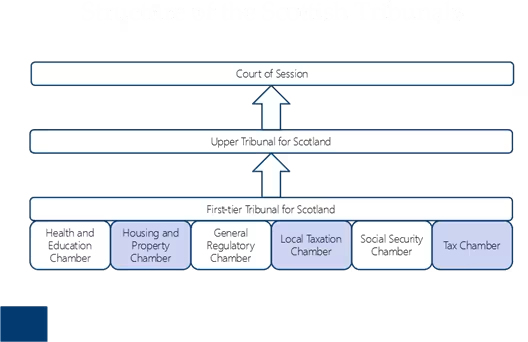
The Tribunals (Scotland) Act 2014 (the 2014 Act) created a statutory framework for the Tribunals in Scotland. The Act created two new Tribunals, the First-tier Tribunal for Scotland and the Upper Tribunal for Scotland, known collectively as the Scottish Tribunals. The First-tier Tribunal consists of a number of Chambers, each with its own jurisdiction(s) and headed by a Chamber President.
The First-tier Tribunal for Scotland deals with first instance decisions. These are cases heard at a Tribunal for the first time. Appeals from the First-tier Tribunal are heard in the Upper Tribunal. In certain circumstances, some matters can be appealed from the Upper Tribunal to the Court of Session.
The 2014 Act brings Scottish Tribunal appointments under the remit of the JABS. The structure of the tribunal service in Scotland is shown as follows-
This note sets out the roles and experience required for each of these chambers of the first tier tribunals, setting out the skills required both for legal members and specialist members. Specialist members are sometime described as ordinary members, but as can be seen in the descriptions below, their specialisms and specialist knowledge are vital to the effective operation of the chambers.
The General Regulatory Chamber
The General Regulatory Chamber deals with Charity Appeals and Transport Appeals.
Charity Appeals
The Charity Appeals jurisdiction deals with appeals against decisions made by the Office of the Scottish Charity Regulator (OSCR), the body which regulates charitable activity in Scotland.
The Chamber is headed by a Chamber President.
Transport Appeals
The Transport Appeals (formerly the Parking and Bus Lane Appeals) considers appeals against Penalty Charge Notices issued by a number of councils within Scotland for parking contraventions and for three councils for bus lane enforcement notifications.
From 1 June 2023 this has also included penalty charge notices relating to the new Low Emission Zones. Other transport related appeals have also been added since then.
Judicial Office Holders in the General Regulatory Chamber
The skills required of judicial office holders are as follows-
Placeholder text for skills/knowledge required by legal members.
Placeholder text for skills/knowledge required by ordinary members.
Health and Education Chamber
Additional Support Needs
The Additional Support Needs jurisdiction Tribunal considers three types of applications – references, regarding the provision of educational support under the Education (Additional Support for Learning) (Scotland) Act 2004; claims, in respect of disability discrimination in school education, under the Equality Act 2010 and freestanding United Nations Convention on the Rights of the Child (UNCRC) applications, under the United Nations Convention on the Rights of the Child (Incorporation)(Scotland) Act 2024.
The Chamber is headed by a Chamber President.
The skills required of judicial office holders are as follows-
Placeholder text for skills/knowledge required by legal members.
Placeholder text for skills/knowledge required by ordinary members.
Housing and Property Chamber
The Housing and Property Chamber considers determinations of rent or repair issues in private sector housing; assistance in exercising a landlord’s right of entry; and relatively informal and flexible proceedings to help resolve issues that arise between homeowners and property factors.
Since 2017, the Chamber has received more private rented cases, being applications provided for by the transfer of jurisdiction from the Sheriff Courts of non-criminal matters arising from regulated, Part VII and assured tenancies (Housing (Scotland) Act 2014 refers).
The Chamber also receives applications for rent assessments, drawing up of terms, evictions and other non-criminal matters arising from the Private Residential Tenancy (Private Housing (Tenancies) (Scotland) Act 2016 refers).
Further private rented sector cases can be heard arising from the letting agents legislation under the Housing (Scotland) Act 2014.
The Chamber is headed by a Chamber President.
The skills required of judicial office holders are as follows-
Placeholder text for skills/knowledge required by legal members.
Placeholder text for skills/knowledge required by ordinary members.
Local Taxation Chamber
The Local Taxation Chamber of the First-tier Tribunal was formed to deal with council tax, council tax reduction, water charges and non domestic rates appeals after 1st April 2023.
The functions of the Valuation Appeal Panels and the Council Tax Reduction Review Panel were transferred to the Local Taxation Chamber in 2023.
The Local Taxation Chamber will hear the following type of appeals:
- Appeals against Council Tax Banding
- Invalid Council Tax Banding Appeals
- Council Tax Liability Appeals (Calculation of Council Tax Liability, Exemptions and Discounts)
- Council Tax Reduction Appeals
- Council Tax Completion Notice Appeals
- Council Tax Penalty Notice Appeals
- Non-Domestic Rates Appeals
- Non-Domestic Rates Complaints
- Non-Domestic Rates Penalty Notice Appeals
- Water Charges Appeals
The Chamber is headed by a Chamber President.
The skills required of judicial office holder are as follows-
Placeholder text for skills/knowledge required by legal members.
Placeholder text for skills/knowledge required by ordinary members.
Social Security Chamber
The Social Security Chamber deals with appeals against decisions by Social Security Scotland about what the law calls assistance. The Chamber and Social Security Scotland, refer to that as benefits.
The Social Security (Scotland) Act 2018 establishes the arrangements for the First-tier Tribunal to hear appeals against determinations by Social Security Scotland on behalf of Scottish Ministers.
The Chamber is headed by a Chamber President.
Judicial office holders comprise legal, medical and disability members. Dependent on the benefit decision appealed against, a tribunal may consist of one, two or three members.
At present the only Social Security Scotland benefits that have a right of appeal to the Chamber are:
- Best Start Grant
- Pregnancy and Baby Payment
- Early Learning Payment
- School Age Payment
- Funeral Support Payment
- Young Carer Grant
- Winter Heating Assistance for Children and Young People
- Scottish Child Payment
- Child Disability Payment
- Adult Disability Payment.
These benefits are awarded by Social Security Scotland. In time more benefits will be devolved to Scotland and all appeals related to these benefits will be heard by this Chamber.
Tax chamber
The Tax Chamber was established to decide appeals relating to Lands and Buildings Transaction Tax and Scottish Landfill Tax.
The Scotland Act 2012 provides the Scottish Parliament with the powers to introduce devolved taxes, particularly those taxes on land transactions and on waste disposal to landfill, effective from 1st April 2015.
As a non-ministerial department of the Scottish Government, Revenue Scotland is the tax authority responsible for the collection and management of the Land and Buildings Transaction Tax (LBTT) and the Scottish Landfill Tax (SLfT).
Revenue Scotland work closely with Registers of Scotland on LBTT and with the Scottish Environment Protection Agency (SEPA) on SLfT.
The skills required of judicial office holders are as follows-
Placeholder text for skills/knowledge required by legal members.
Placeholder text for skills/knowledge required by ordinary members.
Common characteristics
All judicial officer holders in the First-tier Tribunal for Scotland will require-
- To exercise collegiality.
- To prepare for hearings through careful examination and consideration of all case.
- To absorb written and oral evidence, legal arguments, summarise issues, and apply knowledge to arrive at well-reasoned and balanced decisions.
- To engage in judicial proceedings, ensuring proceedings are effectively and efficiently managed whilst discharging the Tribunal’s overriding objective.
- To manage cases actively and expeditiously, and produce or contribute to a high quality of written work.
- To be courteous and considerate to all parties, witnesses, hearing attendees and staff of the Scottish Courts and Tribunals Service, sensitive to diverse needs.
- To ensure that decisions, directions and any orders of the tribunal are made efficiently, effectively and without delay.
- To maintain up to date knowledge of the relevant law in their Chamber, and Chamber, practice and procedures.
- Ensure that parties who are not represented are supported to present their case consistent with the Tribunal’s overriding objective.
- Conduct tribunal hearings remotely (online or telephone), in-person or a hybrid version of these. When sitting in-person or on a hybrid basis, travel throughout Scotland, as required.